Posts Page

  • The Power of Remembrance

    I was leaving a revival where my husband was preaching, and we were talking about miracle stories and how there is power in remembrance, power in talking about what God has done for you. Did you know that it is actually a spiritual weapon? Throughout scripture, God repeatedly tells us to remember. Why do you think that is? It’s because remembrance brings power. It anchors our faith, restores our direction, and fuels our worship. When we forget what God has done, it leads to sin, rebellion, and spiritual drought.

    When the children of Israel crossed the Jordan river, God commanded Joshua to take 12 stones from the river bed and set them up as a memorial (Joshua 4:6). Those stones were reminders of what God brought them through. Likewise, your memories of God’s faithfulness are like spiritual monuments – reminders that if he did it before, he will do it again.

    In Psalm 77, the author of this Psalm was so distraught and depressed that his soul refused to be comforted, and his spirit was overwhelmed. He cried to the Lord, but nothing was changing his state of mind until he started remembering. He remembered, meditated, and talked of God’s doings. There is strength in remembrance and in taking time during prayer to reflect on God’s works and telling others what God has done for you.

    In Deuteronomy chapter 8, Moses warns the people of God of the ease with which they can forget the Lord and his kindness towards them. He urges them to be careful not to do so, but to remember the Lord and all that he has done. When things are good, we should always remember it was God that blessed us, not ourselves. Everything we have is by his grace and mercy.

    When you remember, it builds gratitude. 1 Thessalonians 5:18 – “In everything give thanks, for this is the will of God in Christ Jesus concerning you. “ What is one of the ways you give thanks? By remembrance. Remembering God’s past faithfulness stirs gratitude and prevents pride. Gratitude keeps the heart humble and worshipful. Sometimes we lose our praise not because God stopped blessing us, but because we stopped remembering.

    When you remember, it prevents backsliding and refocuses your purpose. works, they turned to idols. Remembering keeps us anchored to truth and obedience. Revelation 2:4–5 – The church of Ephesus allowed their love for truth to be greater than their love for Jesus. When the early church lost their first love, Jesus didn’t tell them to try harder — He told them to remember. Remembering helps you realign your heart and renew your purpose. Sometimes the cure for spiritual drift is not a new revelation but an old memory.

    When you remember, it strengthens your faith. When you remember what God has done, you gain confidence in what He will do. Memory fuels faith. We saw that in our scripture with Psalm 77. 1 Samuel 17:33–37  – David didn’t just see Goliath; he remembered God’s power. Memory turned fear into faith. David remembered his past victories. David’s confidence wasn’t in his sling — it was in his memory. What Goliath’s in your life could be defeated if you remembered past victories?

    Remembering is more than recalling — it’s reconnecting. It connects your present struggle with God’s past faithfulness and His future promises. When we remember, faith is restored, gratitude is rekindled, and purpose is refocused. Remembering is a spiritual weapon and a spiritual discipline. 2 Peter 3:1 –  “I stir up your pure minds by way of remembrance.” Take time to remember the prayers God answered, the sins He forgave, and the times He carried you through. The same God who was faithful yesterday is faithful today and forever.

  • Timing is Everything

    Have you ever prayed for something and felt like it was taking a long time to get an answer, or that you have had to go through a hard season for a long time? Every believer will go through seasons of waiting. Timing can make the difference between success and failure, peace and frustration, and joy and sorrow. We live in a world that values instant results — instant coffee, instant downloads, instant gratification. We expect our food to be ready from the time we pay at the drive through window to the time we get to the pick-up window. Though this is the pace of natural life, the Kingdom of God doesn’t operate on human schedules; it operates on divine timing.

    Ecclesiastes 3:1 says, “To everything there is a season, and a time to every purpose under the heaven.” Just like we cannot force natural seasons to change, we cannot force the seasons of our lives to move ahead of time. Trust me, if I had the ability to change seasons, I would skip winter and go straight to spring, but I can’t change natural seasons, just as I cannot change spiritual seasons.

    A great example of God’s divine timing is the story of Joseph. He was favored by his father, and his jealous brothers sold him into slavery. Genesis 39 details how Joseph was a servant in Potiphar’s house, and how God favored him even in his hard season. He was betrayed by his family and sold into slavery, yet Joseph was favored by God and made the overseer over the household. God knows how to prosper us and sustain us even through trials.

    Just as things started to improve for Joseph, Potiphar’s wife falsely accused him of trying to seduce her, and he was imprisoned unjustly. Sometimes obstacles come one after another, but even in prison, God favored Joseph. He granted Joseph favor with the keeper of the prison, who gave Joseph charge over all the other prisoners. Even in prison, Joseph remained faithful and obedient to God. He used his gift of interpreting dreams to help Pharoah’s chief butler and baker. We see in Genesis 40:14-15 that Joseph asked the butler to speak to Pharoah on his behalf. Joseph thought this was his chance to get out, but the butler forgot about Joseph. He remained in prison for two more years until Pharoah needed a dream interpreter. We see then how Joseph is remembered and promoted to second in command of Egypt.

    What seemed like a delay was divine design. If Joseph had been released when he wanted, he might have missed the moment when Pharaoh needed an interpreter — the very event that promoted him. He would have been released as a normal, free man, but instead became second in command of Egypt. Because of his ability to interpret dreams, he was able to devise a plan to save many people from famine.  

    God’s timing aligns with His purpose, not our preferences. When our appointed season arrives, no devil, no delay, and no human can stop it. When it is your time, no one can take your place. Many of us are waiting for God to move in situations in our lives. We can learn from Joseph’s story the importance of obedience and serving in the waiting. Joseph didn’t waste his waiting time. Waiting time is not wasted time. It is a time for God to build our faith, humility, and patience. Waiting reveals what is in your heart. Can you trust God when you don’t see progress?

    There is an appointed time for each of us – a time for God to move. We just have to trust the process and wait for our appointed time. When God moves, He moves suddenly and purposefully. We don’t always understand why things happen when they do or why they don’t happen sooner, but we can trust that all things work together for our good.

  • Subscribing To Jesus

    We live in a time where everyone wants us to subscribe to something – YouTube, Netflix, meal services, etc. Whether we are aware of it or not, we sometimes subscribe to things based on certain actions or inactions. One of the definitions of subscribe is to come into agreement to something. That is primarily what I want to explore.

    Have you ever signed up for a promotion and received a free gift with your subscription? I must admit; I have frequently signed up for meal services when they are offering free meal boxes, and then once the promotion is over, I cancel my subscription. Some people treat Jesus how I treat my HelloFresh subscription. They subscribe to him for the gift and then cancel. They never intended to keep the subscription, but only accepted it for what they could get out of it. Some people come to Jesus for the gift, but they don’t want to continue their subscription. Some want him to move based on a situation in their life, but when they get their prayer answered (or not answered how they want), they cancel their subscription. A subscription is only worth what someone is willing to pay for it, and Jesus paid the ultimate price for us to have the ability to subscribe to him. He did the hard part, and all he asks is that we maintain the subscription. There is no unsubscribe button on his end, only ours.

    When we receive Jesus, we are subscribing to him.  When we subscribe to him, we are coming into agreement with what he’s offering us and promising obedience to him. When you subscribe to something, you agree to receive it regularly. If I subscribe to HelloFresh, I expect to receive my box every week. When we subscribe to him, we should be receiving him regularly. The Bible says to take up our cross and follow him daily.

    We must also be careful to whom or to what we are subscribing. If we are not subscribing to Jesus, to whom are we subscribing? In 2 Chronicles 18:1, Jehoshaphat aligned himself with Ahab. Jehoshaphat was a good King, King of Judah, and Ahab was a bad King, King of Israel. Jehoshaphat aligned himself with Ahab to go into battle even though God told him not to, and it almost cost him his life. Be careful what you allow into your spirit. Is it edifying? Is it pleasing to God? We think that some things are not a big deal, but the things we choose to align ourselves with can cost us our lives, or dedication, and our salvation.

    So, what does it mean to agree with him? Amos 3:3 says, “Can two walk together, except they be agreed?” Agreement means in harmony. My husband and I always hold hands when we walk. It is a sign that we are in harmony with each other, walking together. Now, if I were to walk too fast or two slow, we wouldn’t be in harmony anymore. Many times, that is our relationship with God. He reaches out and wants to be in harmony with us, but we don’t allow it. To agree, at least one person in the party must change. If I am walking faster than my husband, then either he has to speed up, or I have to slow down. In Malachi 3:6, God says, “I, the Lord, do not change.” So, if God is unchanging, his ways and thoughts do not change, which means if we are going to agree with him, logically, we must be the ones to change.

    What are the basic requirements for this kind of fellowship to walk with God? Micah 6:8 lists three requirements: To do justly (live righteously), to love mercy, and to walk humbly with God. God says if we cultivate these three aspects of character, the result will be that we will be able to walk with God and have fellowship with him. 

    We see previously in Amos that for us to walk with God, we must agree with his ways and his thoughts, but the Bible also makes it clear that by nature, God’s ways and thoughts are different than ours. In Isaiah 55:6-9, we see that when we turn to God, it’s not enough to just turn in outward act, but what really matters is our inward ways and thoughts. That’s what must be forsaken to turn to God, relate to God, and be reconciled with God. Because God is perfect, and we are yet being made perfect, his ways and thoughts are so much higher than ours. Naturally, the way we are inclined to think is not the way God thinks. As the heavens are higher than the earth is the immeasurable gap between God’s ways and thoughts and ours.

    How do we bridge this immeasurable gap? God shows us in Isaiah 55:10-13. Notice how God uses the imagery of rain and snow to reveal how his ways and thoughts are brought down. As rain and snow comes down from heaven, so does his word come down to us. Sometimes it comes down like rain and immediately saturates and becomes fruitful, and sometimes it hits a hard surface like snow, and it doesn’t saturate and become fruitful until the temperature starts to change.

    When we receive God’s word and let it work in our hearts and minds, we see positive results. What used to be unfruitful will now be productive for his glory. God is an everlasting subscription. We don’t ever have to worry about being canceled, but we do have to come into agreement with his ways and requirements.

  • Which Cup Will You Choose?

    Throughout history, the role of a cupbearer was an influential position due to the proximity to the king. A cupbearer was frequently in the presence of the king, doing whatever the king did. Cupbearers were responsible for drinking wine before monarchs to ensure they weren’t being poisoned.  Nehemiah was a cupbearer for the King of Persia, as an example. The phrase “drinking of the cup” in the Bible symbolizes sharing the consequences of what is in that cup.

    There are two types of cups that I want to explore: the cup of wrath and the cup of salvation.  Psalm 11:6 says, “Upon the wicked he will rain snares, fire and brimstone, and an horrible tempest: this shall be the portion of their cup.” We see this further in the book of Revelation. Revelation 14 describes those who worship the beast as receiving the full measure of God’s wrath. In Revelation 18, there is a call to come out from among these wicked people and a call to punish doubly those who partake in this immoral, lavish lifestyle. We are called to be separate. That does not mean that God does not want to bless us in this life, but what are our priorities? Is he our priority, or is what we can acquire in this world our priority? He said, seek ye first the kingdom of God, and all these things shall be added to you.

    The cup of wrath is promised to those who reject Jesus, but he calls us to drink a different cup. Psalm 116 says, “I will take the cup of salvation, and call on the name of the Lord.” It is our choice. John 3:36 says, “He that believeth on the son hath everlasting life: and he that believeth not the son shall not see life; but the wrath of God abideth on him.” You see, it is one or the other. If you don’t accept Jesus, you are choosing Satan and the path of God’s wrath. There are no gray areas because of God’s hatred of sin. We can’t hold on to things of the world and claim to be holy. We have to fully accept him as our Lord and Savior.

    In Matthew 26, we see Jesus asking God if the cup could pass from him. The cup he was referring to was the cup of God’s wrath. He knew the spiritual weight he was about to endure. The weight of the sins of the whole world. The physical description of what he went through is terrible – the crown of thorns, the mocking, being beaten, but imagine the spiritual suffering that he had to endure – the weight of the sin of the world. He felt for the first time what it was like to be separated from God, to feel abandoned. In Matthew 27, he said, “My God, my God, why have you forsaken me?”

    Jesus drank the full measure of God’s wrath to extend the cup of salvation to us, the cup of his grace and mercy. The cup of salvation does include suffering sometimes, but he said if we suffer with him, we will reign with him. Suffering is not the same as wrath. We may have to go through things sometimes in this life, but I would rather suffer some in this life and spend eternity in heaven than do whatever I want now and spend eternity in hell. When we take the cup of salvation,  we don’t get wrath anymore. We get God and all the benefits of salvation. The question is, which cup will you choose?

  • To Overcome Or Be Overcome

    In the world we live in today, with deception running rampant, I think many people have been convinced that there is some gray area in christianity, a middle ground of sorts. They think they can live however they want and still claim to be a follower of Christ and reap his benefits. The truth is, if you are not overcoming, you are being overcome. If you are not following Jesus, then you are serving the enemy.

    Scripture tells us that Jesus died, he was buried, and he rose again. Because he rose again, we have the power to overcome. Ephesians 2:4-6 says, “But God, who is rich in mercy, for his great love wherewith he loved us, even when we were dead in sins, hath quickened us together with christ, (by grace ye are saved;) and hath raised us up together, and made us sit together in heavenly places in Christ Jesus.” When he got up, we got up. We can overcome because of him.

    There are so many examples of overcoming in the Bible, but one that I find encouraging is the story of Caleb. In Numbers 13, Moses sends 12 spies into the promised land, and out of the 12, only two return with a good report: Caleb and Joshua. Caleb says let’s go and possess it, for we are well able to overcome. The negative spies said, “we are not able to overcome.” They said they were like grasshoppers compared to the giants in the land. Notice that they all went to the same place and saw the same thing, yet they have two totally opposite perspectives.

    In Numbers 14, we see the majority of the people complain, and when Caleb and Joshua try to encourage the people to keep the faith, the people don’t want to hear it.

    Everything is about perspective. If you want to be victorious, consider your perspective. Are you letting the giants in your life bring fear or doubt, or are you choosing to believe the report of the Lord?

    In Numbers 14:28-30, we see God’s response to those who chose the wrong report. He said, “as you have spoken in my ears, so will I do to you.” How many of us would be happy if God said to us, just as you have spoken to me, I will do to you? Are you speaking victorious words/words of an overcomer, or are you speaking words that allow the giants in your life to overcome you? Think back to how you have been speaking the last few days, months, and years. Would you be happy if God said, I will do exactly what you have been saying?

    The Power of life and death is in our tongues. We settle our destiny by the words we speak. All of the 12 spies settled their destiny. Caleb was an overcomer, and he was rewarded for it. five times it says Caleb wholly followed the Lord. Are you wholly following the Lord? He has made provision for you to be an overcomer.

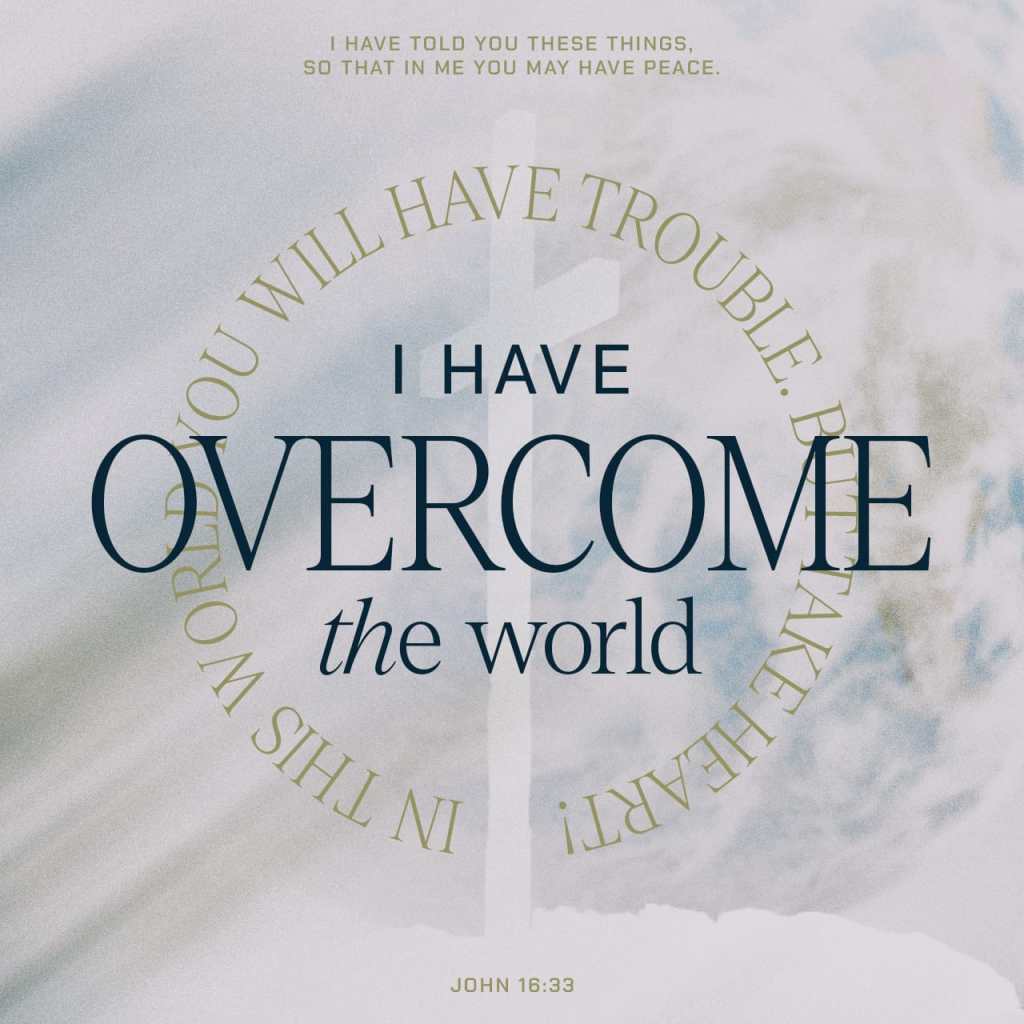
    The beautiful thing about the use of “Have overcome” in John 16:33 is that it is present perfect tense. Jesus could have said “I overcame the world,” which is past tense, but he said i “Have Overcome,” which means the victory didn’t just start in the past and end in the past, but it continues into the present. We don’t just get victory over the enemy in some situations and not others. We are continually victorious.

  • The Power of God in Us

    As believers, there’s an inherited power in us – a power that lives inside of us once we accept Christ into our hearts, but just because it is there, doesn’t mean we are fully operating in it. We must understand what it is to activate God’s power in our lives.

    In Ephesians 1:15-21, Paul explains it’s the same power that raised Christ from the dead that dwells in us – the power of the Holy Ghost, and it’s a power that exceeds/surpasses everything. Notice, he did not pray that they be given power, but that they recognize God’s power in them and that the eyes of their understanding be enlightened. They were believers already. They had faith in Jesus already, yet they were not operating in power. That’s what we must do – come to the revelation of the power in us. In the passage, he strategically lists how this power is far above everything else because we know there are other powers out there. The enemy has power, but none greater than God’s power.

    In Ephesians 3:16-21, Paul reiterates his point by affirming the power resides in us. We see from both scriptures that it’s given to us, works within us, and dwells inside us. “Dwell” comes from the ancient Greek word for permanent home.  The indwelling of Jesus is something for us to know by faith. He wanted them to be filled with all the fullness of God. Every good thing we can experience or even imagine, God can do it, even things beyond our comprehension or ability to imagine with our natural minds…according to the power that works in us. The things he prayed for in the previous verses: spiritual strength, the indwelling of Jesus, experiential knowledge of God’s love, and the fullness of God belong to us, if we can believe it.

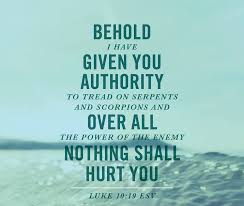
    Luke 10:19 says we have power and authority over all the powers of the enemy. It’s not power in our own strength; it’s a delegated power. When a policeman steps out in traffic, he puts his hand up, and cars stop – not by his own power, but by the authority granted to him. That’s the authority we have in Christ because we are backed by the power of God. Ephesians 6:10 says “be strong in the Lord and in the power of his might,” not ours.

    In Mark 16:15-20, Jesus lists the signs that will follow believers. Verse 20 says, “they went forth, and preached everywhere, the Lord working with them, and confirming the word with signs following.” God will confirm His Word, but first it must be put forth. He will bring the healing, but you and I as believers must lay hands on the sick by faith, believing that God will perform His Word. We have the power and the authority to take the Word of God, the name of Jesus, and the power of the Holy Spirit and defeat the enemy.

    Once we come to the revelation of God’s power working in us, we must know that it belongs to us. I think there’s a misconception that it’s only for certain individuals, such as pastors or those who hold offices, but in Acts 6:1-8, we see Stephen is described as “full of grace and power” and as a result, did “great wonders and signs among the people.” He was assigned to serve tables so the Apostles could devote themselves to preaching and prayer. The only thing that set him apart was that he was “full of faith and the holy spirit.” He was full of the same spirit that was in Paul, and the same power that is within us.

    Once we understand that it belongs to us, we must know how to use it. When adversity arises, use your authority by speaking out what His Word says, using the Name of Jesus. Jesus made it very clear that His Name is the key to all authority: “Whatever you ask in My name, that I will do, that the Father may be glorified in the Son.  If you ask anything in My name, I will do it” (John 14:13-14). In Acts 3 when Peter & John encountered a lame man, they said, “In the Name of Jesus, rise up and walk,” and he did! It wasn’t their own anointing or power that raised the man – it was the authority in the Name of Jesus. That same authority belongs to us. Using the Name of Jesus is how we can tap into it, but we must have faith and believe it will work. Like the first passage we read, it is available to all believers, but we must believe it.

    Prayer is also a vital part of relying on the power of God. Having a prayer life is essential to having a relationship with God. You can’t ask God for something if you’re not communicating with him. There’s also power in reading and knowing his Word, so when the enemy tries to deceive, we have God’s Word to use as a weapon. Satan doesn’t want us to operate in power, but that’s what God’s desire is for us. If we haven’t received that personal revelation, we can pray like Paul for the spirit of understanding, and for the eyes of our hearts to be enlightened.

  • Enduring Through Remembrance

    I was reading today’s daily bible verse (Psalms 77:11-12), and I started thinking more in depth about the importance of meditating on God’s mighty works, as the scripture says.

    We all go through times in our lives where we feel like we can barely hold it together. Sometimes, that makes us feel like God has withdrawn from us, but that’s just what the enemy wants us to think. When our minds are troubled, we must seek God through prayer, and sometimes, we must enlist other believers to hold us up in prayer.

    As I read Psalms 77, what touched me was the raw honesty of the author’s feelings. Most of us don’t want to admit it, but we can get so immersed in our feelings that we question God’s plan for us or his ability to move in our lives. We think because he isn’t answering right away or isn’t giving us the answers we want, that he doesn’t hear us, and our faith becomes depleted.

    Psalms 77:2 says, “In the day of my trouble I sought the Lord: My sore ran into the night and ceased not:  My soul refused to be comforted.” That last line is so profound. Prior to this, he notes that when he cried out to God, God gave ear to him. He knew God was listening, yet his soul still refused to be comforted. God wants to help us, but sometimes, we won’t let go. We don’t want to turn it all over to God because that means being vulnerable to his will and surrendering our own.

    After he explains the depths of his troubles and questions God, we see a shift in perspective. He acknowledges his weakness, but says he is going to remember and meditate on God’s mighty works.

    When troubles come, we have to remember the good things God has done for us – to remember our testimony and the testimonies of others. We must look at the many examples in the Bible of how God delivered his chosen people and remind ourselves that he’s still the same God. When we truly surrender to God’s will, we can have peace in the valley because we know it’s his will that is best for our lives.

  • God’s Offspring

    I was reading in the book of Acts when “offspring of God” jumped out at me. Referring to Christians as children of God is not really a new concept, but what stood out to me was the way in which Paul used this phrase to teach the Athenians about the true, living God.  The Athenians at the time were known for worshiping false idols and had yet to hear and receive the message of Jesus as Christ. Paul is speaking to the Athenian philosophers at the Areopagus and uses words from ancient poets to prove his point.

    Act’s 17:28 says, “For in him we live and move and have our being. As some of your own poets have said, we are his offspring.” The philosopher who wrote “We are his offspring” was referring to the Greek God, Zeus, but Paul used it as an opportunity to correlate it with the true God of the Bible. Paul says, “Therefore since we are God’s offspring, we should not think that the divine being is like gold or silver or stone — an image made by human design and skill” (Acts 17:29). The point Paul is making here is if God were made from stone, wouldn’t we also be made of stone? Yet, since we are alive, then God must be alive, too, if we are his offspring.

    So, what does it mean to be the offspring of God? Romans 8:14 says, “For those who are led by the Spirit of God are the children of God.” Those who have accepted Christ are adopted to sonship. John 1:12-13 says, “Yet to all who did receive him, to those who believed in his name, he gave the right to become children of God — children born not of natural descent, nor of human decision or a husband’s will, but born of God.”

    The life of a child of God will be opposite of the life of an unbeliever (1 John 3:10). A child of God strives to live a life that pleases God. This does not mean that we are devoid of sin, but it means we no longer live in it (Romans 6:6).

    Because we are children of God, we have direct access to God. We can pray to him anytime and anywhere, and he hears us. We have the promise that “we may receive mercy and find grace to help us in our time of need” (Hebrews 4:16). He will supply all our needs “according to the riches of his glory in Christ Jesus” (Philippians 4:19). Most importantly, we have the promise of eternal life with him (Romans 6:23).

  • Levels of Faith

    Faith is something given to us by God. It’s confidence in God and His ability to lead and guide us. A measure of faith is given to us, and it’s our responsibility to nurture that faith through spending time with God and building a relationship with Him. Without faith, we can’t please God (Hebrews 11:6).  

    We see some examples of great faith in the Bible. When the Centurion asked Jesus to heal his sick child, he said, “Lord, I am not worthy that you should come under my roof. But only speak a word, and my servant will be healed. When Jesus heard it, He marveled, and said to those who followed, Assuredly, I say to you, I have not found such great faith, not even in Israel!” (Matthew 8:8-10) Great faith allows God to move unrestricted in our lives.

    Unwavering faith is unbendable. It’s believing God even when the situation doesn’t seem fixable.  Hebrews 10:23 says, “Let us hold fast the confession of our hope without wavering, for He who promised is faithful.” God wants us to have unwavering faith – to believe he will answer our prayers and requests before seeing the results. Abraham’s faith could have wavered since he and Sarah were old in age, but “He did not waver at the promise of God through unbelief, but was strengthened in faith, giving glory to God, and being fully convinced that what He had promised He was also able to perform” (Rom 4:20-21).

    Sometimes, dire situations can test our faith or reveal where our faith is lacking. Jesus and the disciples were crossing the sea of Galilee when suddenly, a great windstorm arose. The disciples woke Him up saying, Rabbi, do you not care that we are perishing? Jesus stood up and rebuked the wind and ordered the sea to be calm. Then He said to them: “Why are you so fearful? How is it that you have no faith?” The disciples allowed the fear of the situation to cloud their faith.

    God wants us to have faith in all circumstances, not just when things look great. The real test is when we are in the storm, whether it be in our relationships, our health, finances, etc. Even when we can’t see a way out, we can have faith that God will work it out. “And we know that all things work together for good to them that love God, to them who are the called according to his purpose.”

  • The Power of Testimony

    The other day, I was reading in the book of John, and the word “testimony” just kept jumping out at me in a way that wasn’t given to me before.

    I’ve written previously about the Samaritan woman at the well; how Jesus gave her the living water, and how she went into town and told them about Jesus. John 4:39 says, “Many of the Samaritans from that town believed in him because of the woman’s testimony, ‘He told me everything I ever did.’” What’s so powerful about this statement is that she was an outcast – a woman so scorned from society that she had to draw water at the hottest time of day. She wasn’t someone of importance by society’s standards, yet many from that town believed in her testimony. Why? Because sometimes God uses the ordinary to reveal his extraordinary power.

    Jesus said the “works that the Father has given me to finish – the very works I am doing – testify that the Father has sent me” (John 5:36). If we truly know God, our lives should be a testament to our relationship with God. The way we live our lives, and the way we treat others should be a light to unbelievers. Ephesians 5:8 says to “live as children of light.”

    In Acts 4, Peter and John had to account for healing a lame man and testified that it was through Jesus they were able to perform this miracle. Acts 4:13 says, “When they saw the courage of Peter and John and realized that they were unschooled, ordinary men, they were astonished, and they took note that these men had been with Jesus.” Again, we see the ordinary theme. The apostles went on to heal many of various infirmities and even through persecution, testified of the goodness of Jesus.

    Sharing our testimonies is vital to encourage both believers and non-believers. Testimony is a form of praise and honor to Christ; giving him glory for all he has done for us. Psalm 66:16 says, “Come and listen, all you who fear God, and I will tell you what he did for me.”

    For me, God has healed my body not once, but twice. He’s healed my mind from anxiety and depression. He’s been so good to me. Don’t be afraid to share your story with others. There is power in your testimony. You never know when your story will draw an unbeliever to Christ or encourage the believer who is going through a similar situation as you.  

    Psalm 105:1 “Give thanks to the LORD and proclaim his greatness. Let the whole world know what he has done.”